When Your Family Tree Gets Complicated: A Real Guide to Divorced Parents on Your Wedding Day
If your parents are divorced, you already know that your wedding day comes with an extra layer of planning that most guides don't fully address. The standard advice—"have both parents walk you down the aisle!"—sounds nice in theory, but the reality of divorced, remarried, or estranged parents is rarely that tidy.
The truth is, there's no single right answer to most of these questions. What works beautifully for one family would be a disaster for another. What matters is that you make intentional choices—ones that reflect your actual relationships and your actual priorities—rather than defaulting to tradition or avoiding the conversation altogether until the morning of the wedding.
Let's work through the moments that tend to get the most complicated.
The Walk Down the Aisle: More Options Than You Think
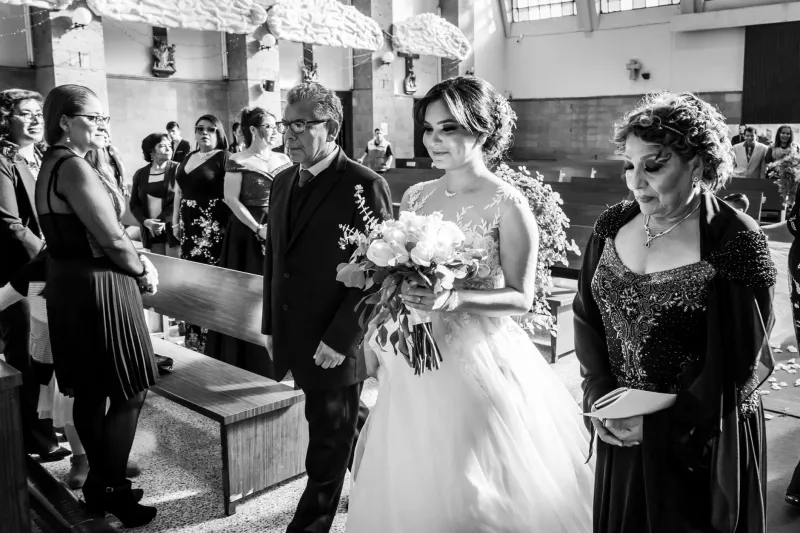
The traditional image of a father walking his daughter down the aisle was designed for a world where most families looked a certain way. Yours might not. Here are the options couples actually use:
Both parents walk you down together. This works when your parents are amicable and can stand next to each other without tension. If they're genuinely at peace with each other—even if they're no longer together—this can be a beautiful, unified moment. It does not work if the two of them being in physical proximity creates visible discomfort.
Each parent walks you for part of the aisle. One parent walks you halfway, the other takes over from there. This is a graceful solution when you want to honor both without forcing them to interact. It requires a brief rehearsal so everyone knows the cue.
You walk alone. Increasingly common, and not a statement about anyone's parenting. Walking yourself down the aisle is a powerful, intentional choice—and it sidesteps the entire question of who gets the honor.
A stepparent participates. If a stepparent raised you and the relationship is close, including them in the processional is entirely appropriate. You might walk with your biological parent and stepparent on either side, or have your stepparent seated ceremonially while your biological parent walks with you.
A sibling, close friend, or grandparent walks you. When parental relationships are estranged or painful, many couples choose someone who has genuinely shown up for them. There's no rule that says it has to be a parent.
The key is to make the decision early, communicate it clearly to everyone involved, and give your officiant a heads-up so they don't say anything during the ceremony that inadvertently creates an awkward moment.
The Processional Order and Seating
For ceremonies where parents are seated before the processional begins, the standard is for the mother of the groom to be seated first, followed by the mother of the bride (as the last person seated before the wedding party enters). But when parents are divorced and remarried, this gets complicated fast.
A few practical approaches:
- Seat stepparents with their spouse (your biological parent), not separately. This keeps couples together and avoids the awkwardness of stepparents sitting alone.
- If parents have contentious relationships, seat them on opposite sides or in rows that don't require them to acknowledge each other. You don't have to put both sets of parents in the front row if that arrangement creates tension.
- Communicate seating to your ushers in advance. Don't leave it to chance. Write it down, give your ushers a cheat sheet, and rehearse it.
For the recessional, the couple walks out together, followed by the wedding party. Parents typically exit after the wedding party. If your parents will need to be guided out in a specific order to avoid an awkward hallway encounter, plan that too.
Family Photos: The Part That Actually Takes the Most Planning
Family portraits with divorced parents are where most of the day's tension tends to surface—not because people are trying to cause drama, but because no one thought through the logistics in advance.
Here's a framework that works:
Create separate family photo groupings. Rather than trying to get one big "family" shot that includes everyone, plan distinct groupings: you with your mother and her family, you with your father and his family, you with your stepparents if those relationships warrant it. This removes the pressure of forcing people into the same frame.
Share the shot list with your photographer before the wedding day. Your photographer cannot read your family dynamics. Give them a written list of every grouping you want, including who is and isn't in each one. Be specific: "Mom, stepdad, me, and my two half-siblings" is more useful than "Mom's side."
Schedule family photos strategically. If your parents genuinely cannot be in the same space without conflict, schedule their photo groupings at different points in the day—one set before the ceremony, one set after. Your photographer can accommodate this with advance notice.
Brief your photographer on any estrangements. You don't need to share the full family history. A simple "my father and stepmother are not speaking, please don't try to group them together" is enough.
Reception Toasts and the Parent Table Question
The traditional head table or parents' table setup assumes everyone is happy to sit together. When that's not the case, you have options.
For toasts, you are never obligated to give every parent a microphone. If a parent's toast would be more about airing grievances than celebrating you, it's okay to limit the toast list. Frame it as keeping the program tight: "We're keeping toasts to the best man and maid of honor to keep things moving"—no one needs to know the fuller reasoning.
For seating, many couples with complicated family dynamics skip the traditional parents' table entirely and seat each family unit with their own extended family or friends. This is increasingly common and completely acceptable. Your parents don't need to be at the same table just because they're both your parents.
If you do want a parents' table and the relationships allow for it, seat stepparents beside their spouses rather than at opposite ends. Putting stepparents at the far end of a table from their spouse while biological parents sit together is an easy way to accidentally signal a hierarchy you didn't intend.
The Conversation You Need to Have Before the Wedding
All of this logistics planning only works if the humans involved know what to expect. The single most effective thing you can do is have direct, private conversations with each parent before the wedding—not a group conversation, separate ones—where you walk them through what you've planned and why.
You don't need to justify every decision. But giving people a heads-up about where they'll be seated, when they'll be called for photos, and what role they'll play in the ceremony removes the element of surprise that tends to generate conflict.
Most parents, even complicated ones, want their child's wedding to go beautifully. When they understand what you need from them, they usually rise to the occasion.
One Last Thing
Your wedding day is not the day to resolve years of family tension. It's also not the day to pretend that tension doesn't exist. The goal is to plan around the reality of your family—with honesty, flexibility, and enough advance thought that no one is figuring it out in real time.
Your family is your family. All of it—complicated parts included. Plan for it accordingly, and then let yourself enjoy the day.